
Searching Criminal Dockets in Ohio
No single public search covers criminal cases in every Ohio trial court. The Supreme Court of Ohio's trial-court directory points you to local courts. It maps the system rather than returning case results. Two statewide tools have narrow scope. The Supreme Court ECMS handles that court's own matters. The Court of Claims Odyssey portal covers Court of Claims cases. Neither one reaches ordinary county criminal dockets.
Begin with the Ohio complaint, citation, or indictment in hand. Match the court and division named there. Then run that court's official case inquiry by case number or party name. Local case-number formats differ across Ohio, and so do the search menus. When a portal returns nothing, ask the court or clerk about the case. It may sit in another division or be indexed under a different name. It may also have been archived or closed off by access limits. One more caution: an Ohio statistics dashboard reports court workloads, not individual criminal cases.
Online search is only one way in. Under Ohio's current court-access rules, anyone may inspect public case records at the courthouse during normal business hours. What displays remotely can be narrower, though. A clerk counter, a records room, or a public terminal may all work. Call the division holding the case first to confirm. Many Ohio clerks take record requests by email, mail, or counter pickup. But the state has no single case-copy form or statewide records desk. For transcripts, ask the court reporter directly.
- Read the Ohio charging paper for the county, court, division, and case number.
- Use the official Ohio trial-court directory to open that court's criminal or traffic case search.
- Search the exact Ohio case number first; use the name and date filters only as the local portal allows.
- Compare the newest Ohio docket entries with the filed judgment or order, not just a calendar listing.
- For an Ohio docket sheet or certified copy, choose the county in the Ohio County Directory and contact the clerk that holds the case.
Ohio Criminal Docket Search Limits
A directory beats a blind docket search. An Ohio directory can point you to every trial-court jurisdiction. You need not search every docket one by one. That matters here. A case missing from one vendor's search does not mean no court record exists. Depending on the charge and its stage, a case may sit elsewhere. It could be with a Mayor's Court, a Juvenile Court, or an appellate district instead.
The Supreme Court directory is the starting map for Common Pleas, Municipal, and County Courts. Open it before trying a broad web search. Then follow the court named on the case paper. Two exceptions handle their own matters. These are the Court of Claims portal and the Supreme Court ECMS. And Ohio eStats is aggregate data, not a criminal case lookup.
The official Ohio trial-court directory shows the local route. It leads to the court that can confirm the live record.
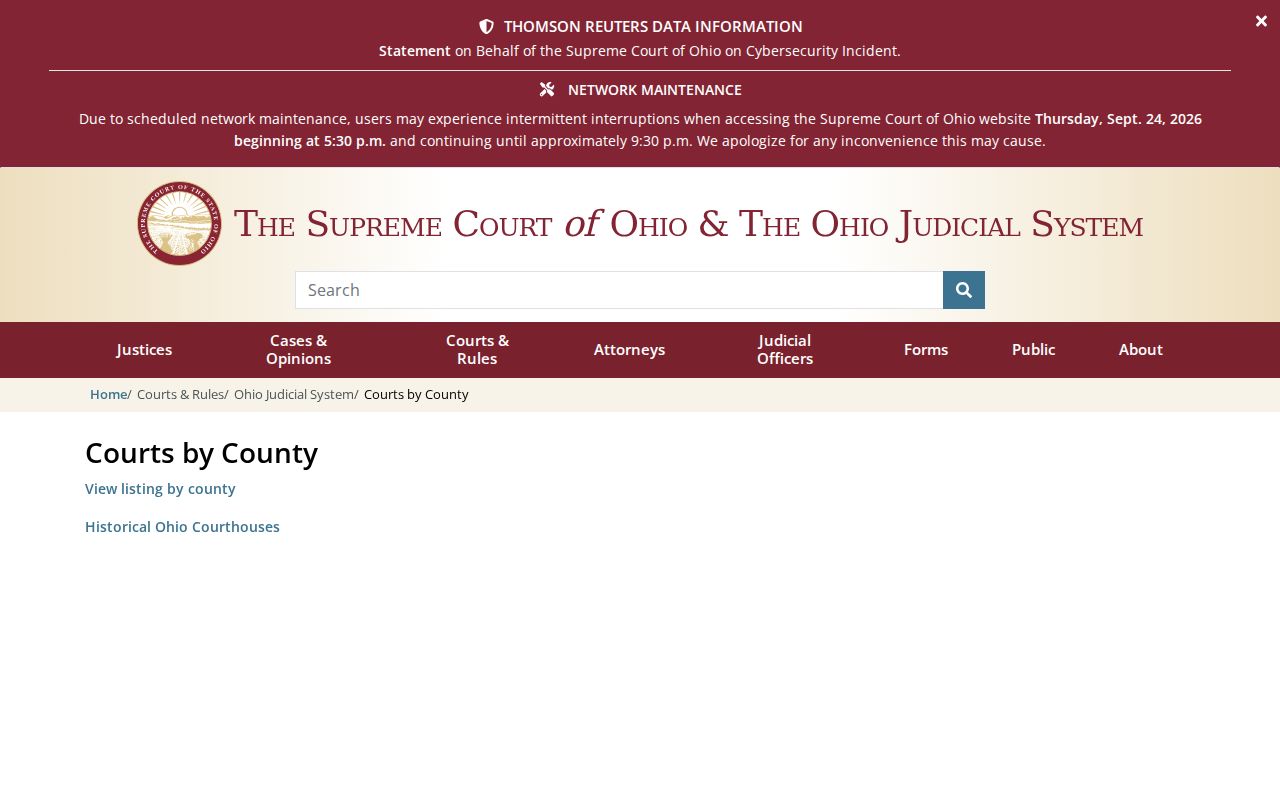
Think of this Ohio court directory as a map. It gets you to the right court but does not replace the local clerk's case search or docket sheet.
What an Ohio Criminal Docket Shows
Ohio law spells out what a Common Pleas clerk keeps: R.C. 2303.12 names the appearance docket, trial docket, journal, and execution docket. A public portal is different. It may show only a summary and a dated case history. Remember that an Ohio docket line is not the signed filing behind it, and a displayed field does not prove that every court shows that field online.
| Case number | The court-assigned identifier. Ohio local formats vary, so use the number on the official notice: case number shown on court paper. |
|---|---|
| Case type and court | Ohio local portal filters may identify the court, division, and criminal case category. |
| Charge or cause | An Ohio search form may offer statute or cause filters; the charge and offense level must be checked in the filed case record. |
| Entries and settings | Ohio docket entries can record filings, hearing notices, motions, or orders. Local labels are not standardized statewide. |
| Plea and disposition | Read the signed Ohio journal entry or judgment for the result. A case-status label may not explain the outcome of each count. |
| Documents | A portal may omit images. Ask the custodian for the filed document or a certified copy when needed. |
Treat a public Ohio criminal docket entry as a pointer. Confirm the charge, plea, and result in the controlling document, not the summary line. Personal details may be redacted, and bond amounts, courtroom details, and financial fields depend on the local system.
Ohio Criminal Portal Fields Vary
Ohio's local portals do not share one field set. The Warren County Common Pleas inquiry, for instance, lets you search by name or case number and filter by dates opened or closed, birth year, case and court type, cause, party type, division, and statute. Its clerk says the portal covers that court's criminal, civil, and domestic cases, with history back to May 1991 and reduced references before that. Filters narrow a query; they do not guarantee which details display in every result, so check the local case record.
The Hamilton County Clerk's name-search page is another local example, offering name and date-of-birth options. It is not a statewide Ohio standard. Just because a form asks for something does not mean the case view shows a particular charge, bond, disposition, or event.
The next image shows the Warren Common Pleas search form, not an opened case result.
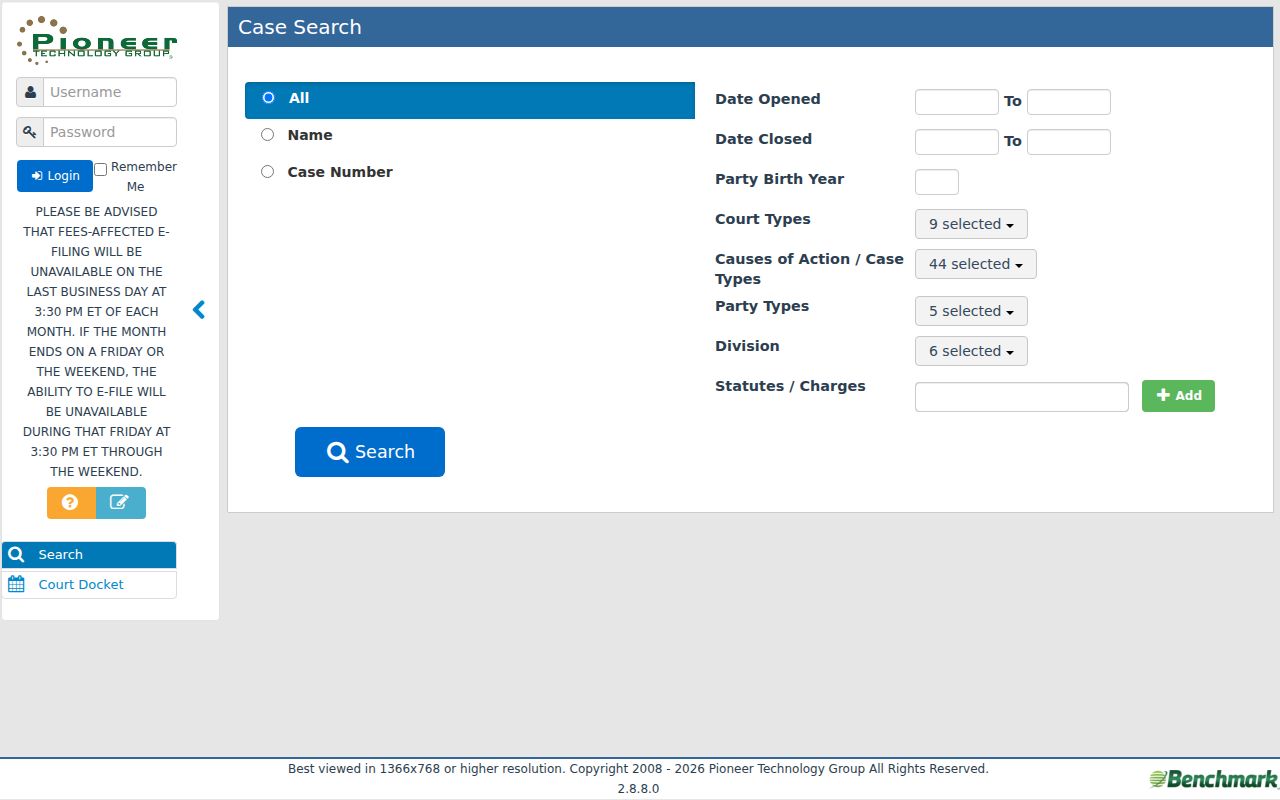
This view illustrates one local Common Pleas search design. It is not a shared Ohio interface. The next image shows the Hamilton County name-search form, another local example rather than a statewide standard.
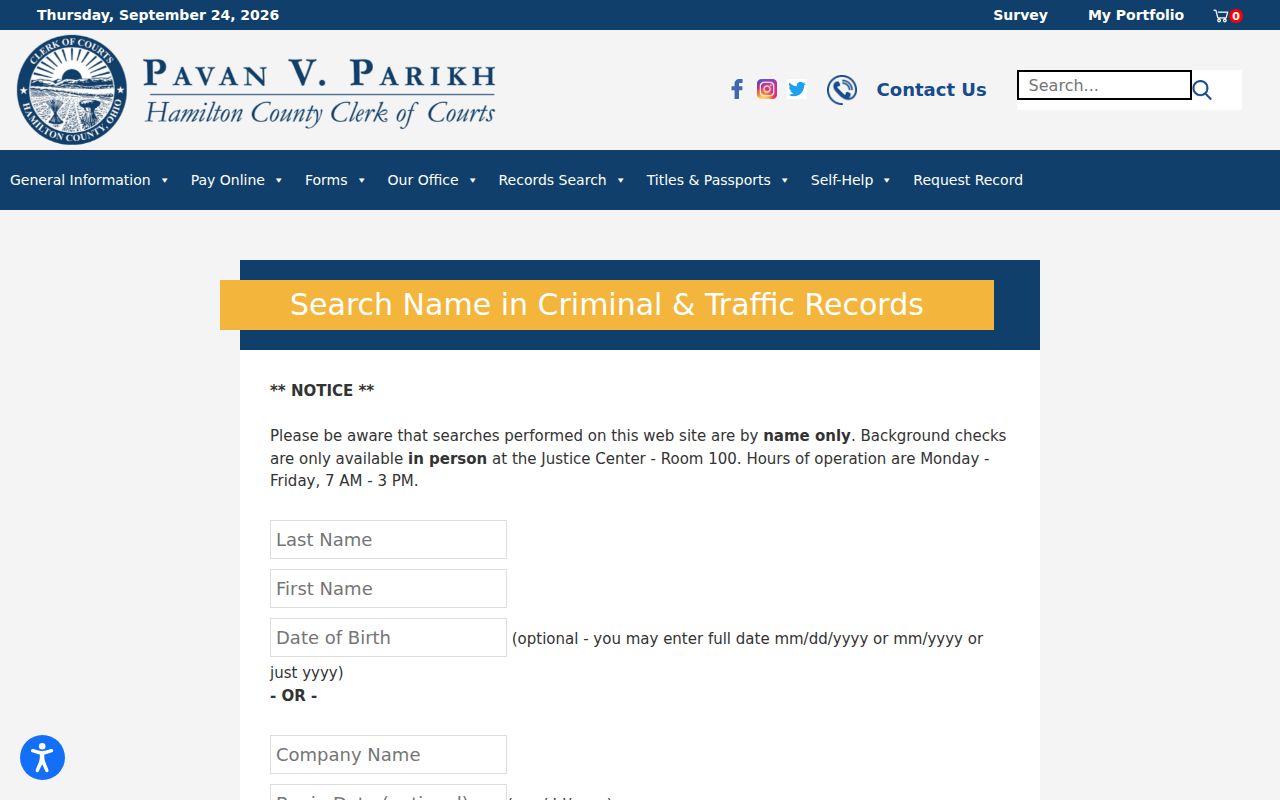
The Hamilton form shows search controls, not a criminal case record or result. Request any missing filing from the clerk that holds it. Note: A local case search can return a docket without document images, so ask for the specific filing from the office that keeps it.
Stages of an Ohio Criminal Case
Most adult criminal cases in Ohio get started one of three ways. The entry point may be a complaint, a citation, or an indictment. From there, the docket may show an initial appearance or arraignment. It may also list release conditions, pretrial activity, motions, a plea or trial, a judgment, and post-judgment steps. Treat that list as a range of possibilities. It is not a fixed set of Ohio docket codes. Plenty of cases end early. Others run long, gather extra entries, or spawn a separate appeal with its own record.
Possible Ohio docket flow: Complaint or indictment › Initial appearance › Pretrial and motions › Plea or trial › Judgment and sentence › Appeal or post-judgment action
A docket entry only proves an event was scheduled, not that it happened. A motion is a request, not a ruling. The later court entry or signed order tells you what the judge actually decided.
When an Ohio Felony Changes Courts
An Ohio felony can leave more than one docket trail. The case often starts in Municipal or County Court on a complaint or preliminary proceeding. After bindover or indictment, the Common Pleas General Division takes over. The county Clerk of Courts keeps the case file there. A new case number may follow. So the first result you pull may not be the trial docket. When a felony search seems to stop early, compare carefully. Check the court and case number on the lower-court paper against any indictment or Common Pleas notice.
Search each Ohio court's record for the part it handled. A notice of appeal opens a third, separate docket. It goes to the Ohio Court of Appeals district for the case. The Supreme Court docket is one more layer, but only if a matter reaches that court. Whenever you ask a clerk to trace the record, bring the right papers. Have the court name, case number, and filing date for each stage together.
Where Ohio Criminal Dockets Sit
The charge and the stage of the case tell you which Ohio court holds the docket. Every local clerk keeps its own trial-court records. A case can also climb from one court level to another as it moves forward. Juvenile matters sit in a separate division. That division has its own access rules. Appeals stay with the appellate district, not on another page of the trial-court portal.
| Court level | Criminal docket commonly covers | Record route |
|---|---|---|
| Ohio Municipal or County Court | Misdemeanors, traffic offenses, and preliminary felony proceedings, depending on local jurisdiction | The local court clerk or county Clerk of Courts where that office also serves as clerk |
| Ohio Common Pleas General Division | Felony trial and sentencing | County Clerk of Courts |
| Ohio Mayor's Court | Qualifying local ordinance and state traffic matters | Mayor's Court clerk or administrator; appeals go to Municipal or County Court |
| Ohio Juvenile Court | Delinquency and related jurisdiction | Juvenile Court or division clerk, subject to access rules |
| Ohio Courts of Appeals | Criminal appellate review | Clerk of the relevant appellate district |
Start with the Ohio County Directory to reach the county where the case was filed. Then pick the court and division named on the record. Clerks vary: some Ohio Municipal Courts use the county Clerk of Courts. Others run a separate clerk office. Confirm custody through the court directory or the clerk itself. Never assume one county office holds every docket.
An Ohio Arraignment Is Not a Plea
An arraignment on an Ohio calendar is just a scheduled event. It does not prove the defendant appeared or entered a plea. Calendars and docket histories use different local labels. Ohio has no statewide trial-court event-code list. So if an online entry says arraignment, pretrial, or hearing, read the later entries to learn whether the court continued the date, recorded a plea, or issued an order. A hearing notice is never the outcome. A filed motion does not show it was granted. A short status label may not cover each count. The signed journal entry or judgment is the court's result. If the docket and the notice disagree, call the clerk. For current hearing-date steps, see Ohio Court Dates. Note: The newest filed order can change an earlier hearing notice. Confirm any disputed setting with the court that has the case.
Sealed Criminal Dockets in Ohio
Ohio court records are generally presumed open. Public access still depends on the current Rules of Superintendence, statutes, and any court order. Going through the court itself can yield more than a remote portal does. A missing online result does not mean the criminal case is sealed. The file may simply be older, held by a different division, or outside that website's coverage. Ask the clerk which access rule applies.
The Ohio public-records statute governs records of public offices. Judicial case files answer mainly to court-access rules. Online access never promises that every filing image is posted. Personal identifiers can be redacted, and juvenile or sealed records carry their own limits.
Ohio access rules:
Sup.R. 11.09-11.16 govern public access, redaction, and restriction procedures; courts can limit remote display without making every part of a file unavailable.
R.C. 149.43 covers Ohio Public Records Act requests for public-office records. It is not the general request route for a judicial case file.
R.C. 2303.12 describes the Common Pleas general docket and case files maintained by the clerk.
Ohio Juvenile Dockets Have Separate Rules
A public adult criminal search and a juvenile case search are not the same thing. Ohio Juvenile Rule 37 and R.C. 2151.356 create special access and sealing rules for juvenile records. A juvenile case may never appear in an ordinary public name search, or the public information may be thin. The juvenile court clerk can explain the permitted route for an authorized person.
Adult sealing works differently. It follows a court process and the applicable statute, never an inference from an empty search. The court that handled the case decides access under its rules and any order. If a search returns nothing, first check spelling, court, division, and older-file coverage, then ask the court holding the record whether a restriction or archive applies. Keep the categories straight, too: an absent public result, a redacted document, and a sealed case are three different conditions under Ohio law. Note: Juvenile access limits and adult sealing rules come from different legal paths, so ask the court holding the record which procedure applies.